
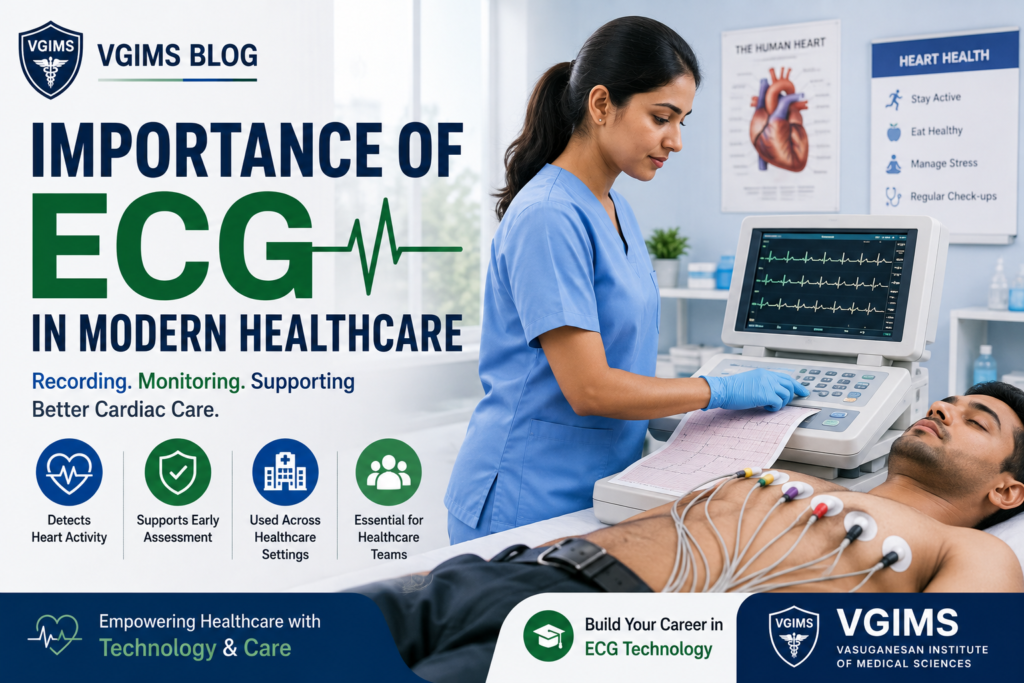
The Role of ECG in Modern Healthcare
The heart is an important part of the human body.
Medical teams need tools that can help them check the heart’s activity.
One of those tools is an ECG, or electrocardiogram.
ECG technology records the signals produced by the heart and creates a visual tracing.
It is used in hospitals, clinics and other healthcare facilities.
What Does ECG Stand For?
ECG stands for Electrocardiogram.
The test captures the activity of the heart.
Small sensors called electrodes are placed on the patient’s skin.
The electrodes detect the heart’s signals and send them to the ECG machine.
The machine produces a waveform or pattern.
Why Is ECG Important?
An ECG can give healthcare professionals information about:
- Heart rate
- Heart rhythm
- Electrical activity
- Certain changes in how the heart works
It can be part of a broader patient assessment.
When Is ECG Used?
Healthcare professionals may use an ECG when assessing symptoms such as:
- Chest discomfort
- Palpitations
- Shortness of breath
- Dizziness
- Fainting
- Irregular heartbeat
The need for an ECG depends on the patient’s situation.
ECG in Emergency Situations
ECG can be helpful in emergency settings.
Emergency departments may use ECG machines when patients need cardiac assessment.
Trained ECG technicians can support the healthcare team by preparing patients and obtaining appropriate recordings.
ECG in Hospitals and Clinics
ECG is used in healthcare environments including:
- Hospitals
- Cardiology departments
- Emergency departments
- Clinics
- Diagnostic centres
- Other healthcare facilities
What Does an ECG Technician Do?
An ECG technician works with ECG machines and supports the healthcare team.
Their work can include:
- Preparing patients
- Explaining the procedure
- Setting up ECG equipment
- Applying electrodes correctly
- Recording ECGs
- Checking the quality of the recording
- Maintaining equipment
- Following infection-control procedures
ECG readings and interpretation should be performed by an appropriately qualified healthcare professional.
Why Is Accuracy Important?
An ECG needs to be recorded carefully.
Incorrect electrode placement or patient movement can affect the quality of the recording.
This is why ECG technicians need to be skilled and pay attention to detail.
Skills for ECG Technology
Students who want to work in ECG technology can build skills such as:
Technical Skills
Learning how to use ECG machines and perform recording procedures.
Attention to Detail
Following correct electrode-placement procedures.
Communication
Explaining the process clearly to patients.
Patient Care
Helping patients feel comfortable during the procedure.
Equipment Handling
Using and maintaining ECG machines properly.
ECG Technology as a Career
Students interested in healthcare and diagnostic technology can explore ECG training.
Training can help students understand ECG machines, patient preparation, electrode placement and ECG recording procedures.
Practical training can help build these abilities.
ECG Technology at VGIMS
VGIMS offers the Diploma in Electrocardiogram Technology.
The programme is for students who want to work in ECG technology and healthcare support roles.
VGIMS also offers programmes including:
- Diploma in Hospital Nursing & Midwifery
- Diploma in General Nursing & Midwifery
- Diploma in Medical Laboratory Technology
- Diploma in Dental Care Assistant
- B.Sc. Nursing
- B.Sc. Medical Laboratory Technology
- B.Sc. Cardiovascular Technology
- B.Sc. Renal Dialysis Technology
- B.Sc. Imaging Technology
- B.Sc. Respiratory Technology
Students should check the course details, eligibility and admission requirements directly with VGIMS.
Conclusion
ECG technology is a part of modern healthcare.
It helps capture the activity of the heart and provides useful information for cardiac assessment.
For students interested in allied health and diagnostic technology, ECG training can offer important skills and knowledge.
Frequently Asked Questions
1. What is an ECG?
An ECG is a test that captures the electrical activity of the heart.
2. Why is ECG important?
ECG provides information about heart rate, rhythm and electrical activity as part of a clinical assessment.
3. What are ECG electrodes used for?
Electrodes detect signals from the heart and allow the ECG machine to record them.
4. Where do ECG technicians work?
ECG-related work can be found in hospitals, clinics, testing centres, cardiology departments and other healthcare facilities.
5. Does VGIMS have a Diploma in ECG Technology?
Yes. VGIMS offers a Diploma in Electrocardiogram Technology.