
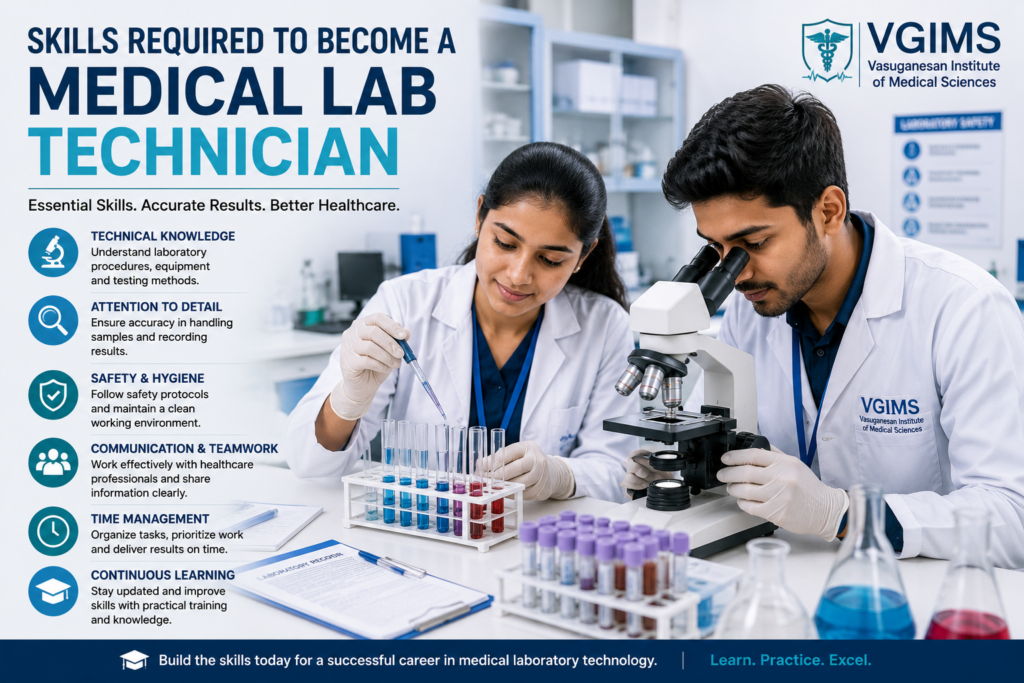
Skills Required to Become a Medical Lab Technician
Medical laboratory technicians contribute to healthcare by working with laboratory samples and supporting the information needed for care.
Students who want to enter this field need more than knowledge. They also need ability, accuracy attention to detail communication and a strong sense of responsibility.
At Vasuganesan Institute of Medical Sciences (VGIMS) students interested in medical laboratory careers can work toward developing the skills required for laboratory environments.
Build a Strong Scientific Foundation
A medical lab technician needs to understand the concepts behind laboratory work. This knowledge helps students understand procedures and the importance of results.
Students should develop knowledge of:
- Laboratory procedures
- Sample handling
- Medical terminology
- Laboratory equipment
- Testing methods
- Safety practices
- Record keeping
A foundation can make practical learning easier and help students understand their responsibilities.
Accuracy and Attention to Detail
Laboratory work requires handling of samples and information. Small mistakes can affect the accuracy of results.
Students should develop the habit of:
- Checking information
- Following procedures step by step
- Handling samples correctly
- Recording information accurately
- Keeping work areas organised
- Reviewing completed work
These simple habits can become professional skills.
Develop Practical Laboratory Skills
Practical learning gives students an opportunity to understand how laboratory work is carried out.
Students can develop confidence by learning about:
- Laboratory equipment
- Sample processing
- Testing procedures
- Safety protocols
- Cleaning practices
- documentation
Hands-on experience helps students connect what they learn in class with practical laboratory responsibilities.
Understand Laboratory Safety
Safety should always be taken seriously in a laboratory.
Students should learn about:
- Personal protective equipment
- Safe sample handling
- Hygiene
- Contamination prevention
- Safe disposal
- Laboratory safety procedures
Following safety practices protects everyone working in and around the laboratory.
Communication and Teamwork
Medical lab technicians work as part of a healthcare team. Good communication helps them understand instructions, share information and work efficiently with others.
Students should practise:
- Listening
- Communicating clearly
- Working with colleagues
- Sharing information responsibly
- Asking questions when necessary
These skills can help students adjust to professional healthcare environments.
Time Management and Responsibility
Laboratory work may involve tasks. Students should learn how to organise their responsibilities while maintaining accuracy.
Good time management can help students complete work efficiently without ignoring safety and quality procedures.
Responsibility is equally important because laboratory work contributes to decisions made by healthcare professionals.
Developing Your Career at VGIMS
At Vasuganesan Institute of Medical Sciences (VGIMS) students interested in medical laboratory careers can focus on developing professional abilities alongside their healthcare education.
Building knowledge, accuracy, safety awareness, teamwork and communication skills can help students become better prepared for laboratory work.
A successful medical lab technician needs a combination of knowledge, practical ability and professional responsibility. Developing these skills during education can provide a foundation for a healthcare career.
Frequently Asked Questions
1. What is the important skill for a medical lab technician?
Accuracy and attention to detail are essential along with knowledge and practical laboratory skills.
2. Why should medical lab students learn safety procedures?
Safety procedures help protect laboratory workers, patients and others from risks and contamination.
3. Are communication skills for medical lab technicians?
Yes. Laboratory professionals need to communicate with colleagues and other healthcare professionals.
4. How does practical training help students?
It helps students understand laboratory equipment, procedures, sample handling and professional responsibilities.
5. Why are teamwork skills important, in laboratory careers?
Laboratory services are part of care so technicians need to work effectively with other healthcare professionals.