
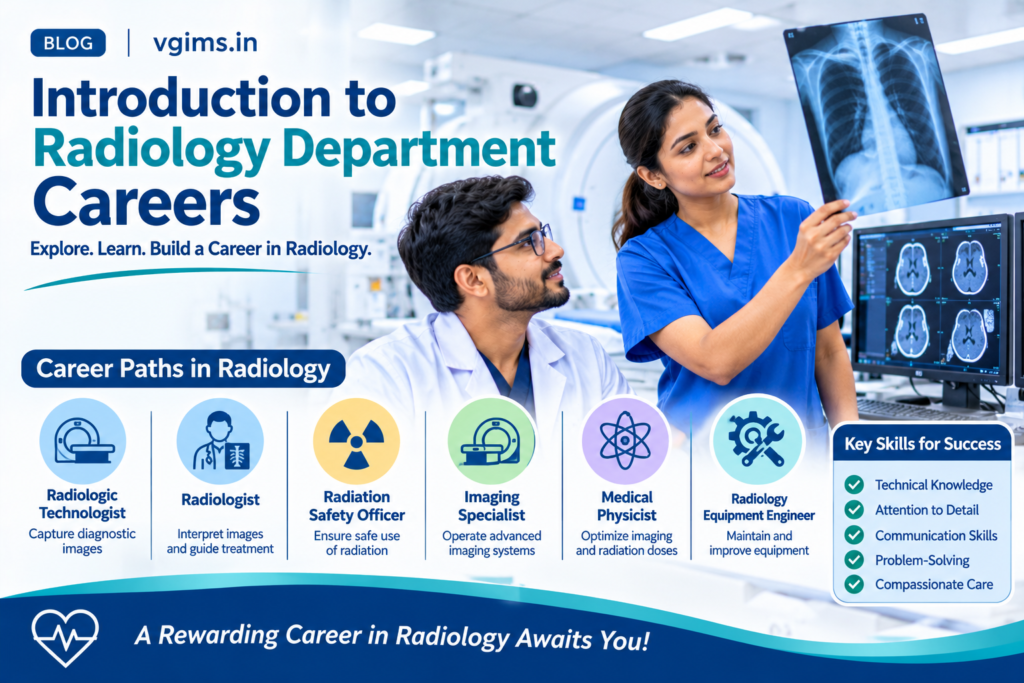
Introduction to Radiology Department Careers
In today’s world of modern healthcare, a radiology department uses technology and various imaging techniques to help physicians to diagnose and control different health conditions. Radiologists perform different types of medical imaging such as X-ray imaging, computed tomography (CT), Magnetic resonance imaging (MRI), ultrasound, and mammography.
If you want to develop your skills in healthcare and medical technology, radiology department can be a good option.
1. What Is a Radiology Department?
It is a specialized department of a hospital or diagnostic center, which produces various images for the diagnosis of injuries and illnesses.
Radiology professionals coordinate with physicians and other healthcare professionals to perform imaging procedures accurately and safely.
2. Different Careers in Radiology
Radiology offers several career opportunities:
Radiology technician – assists in performing imaging procedures and operates the radiographic equipment properly.
X-ray technician – performs routine X-ray examinations of the patient’s body while taking into consideration the radiation safety measures.
CT scan technician – supports the procedure of computed tomography.
MRI technician – assists in the procedure of magnetic resonance imaging.
Ultrasound technician – works with ultrasound equipment to produce images of the examined area of the body, depending on his qualification.
Radiologist: A qualified medical doctor who specialises in interpreting images and assisting in diagnosis.
3. Key Skills Needed for Radiology Careers
Skills needed by radiology professionals are both technical and interpersonal such as:
Knowledge of medical imaging machines
Human body anatomy knowledge
Communicating with and supporting patients
Attention to details
Basic computer and digital imaging skills
Awareness of radiation protection
Working in teams and maintaining professionalism
These skills help radiologists remain accurate and offer quality care to patients.
4. Understanding Medical Imaging Technologies
The following are technologies used by the radiology department for diagnosis:
X-Ray: Used to look at bones, joints and some conditions affecting the chest.
CT Scan: Creates cross-sectional pictures of the body.
MRI: It uses magnets and radio waves to form detailed pictures of the insides of the body.
Ultrasound: It uses sound waves to examine organs and soft tissues inside the body.
Mammography: It is a specialised breast imaging.
Every imaging type has its particular use and needs to be trained on accordingly.
5. Patient Safety and Care in Radiology
The safety of the patient is one of the key responsibilities in radiology. Radiologists help patients understand the procedure, prepare them for the examinations and follow As per the instructions of the supervising healthcare team.
Important safety considerations include:
Compliance with radiation safety instructions.
Use of protective gear, where necessary.
Verification of patient identity prior to examination.
Maintenance of equipment cleanliness.
Adherence to infection control protocols.
Patient instructions and reassurance.
6. Workplaces for Radiology Professionals
Recognized qualifications and experience may allow qualified radiology professionals to pursue various career opportunities in healthcare organizations.
Multispeciality hospitals
Government and private hospitals
Diagnostic imaging centers
Speciality clinics
Medical research centers
Healthcare technology organizations
Practical experience and continual learning may promote career advancement.
7. The Future of Radiology Careers
Modern medical imaging is developing in terms of digital technologies, artificial intelligence-assisted image analysis, advanced scanning equipment, and improved diagnostic processes.
Such developments are opening up new opportunities for learning for radiology professionals. Familiarity with digital imaging systems, patient safety issues, and new technologies may assist students in getting prepared for changes in the healthcare environment.
8. Building a Career in Medical Imaging
Interested students should explore recognized courses available to them in relation to their qualifications and career interests.
Practical experience, equipment familiarity, patient communication skills, and professional guidance are the essential components of career preparation.
It is essential that before registering for the program, prospective students ensure that they are aware of the course recognition, admission requirements, clinical training schedule, and the professional scope of practice.
Conclusion
The radiology department career is a blend of technology and the provision of patient services. From X-ray investigations to modern techniques of medical imaging, radiology specialists help in the diagnosis process.
Therefore, with proper education and training, students can have an impactful career in the area of medical imaging.
Frequently Asked Questions
1. What is the role of the radiology department?
This department conducts examinations using medical imaging techniques that assist the doctors in diagnosing patients’ illnesses.
2. What are the common radiology career paths?
There are various positions such as radiology technologist, X-ray technologist, CT scan technologist, MRI technologist, ultrasonography technologist, and radiologist in radiology. Each career requires different training.
3. What are the necessary skills for radiologists?
These include technical skills, understanding of anatomy, patient communication skills, attention to details, and knowledge of radiation safety.
4. Where can radiology specialists work?
They can work in hospitals, diagnostic imaging centers, specialty clinics, and other healthcare institutions depending on the qualifications.
5. Is radiology a good career path?
The field of radiology is an interesting one for students who have an interest in medicine and health care.