
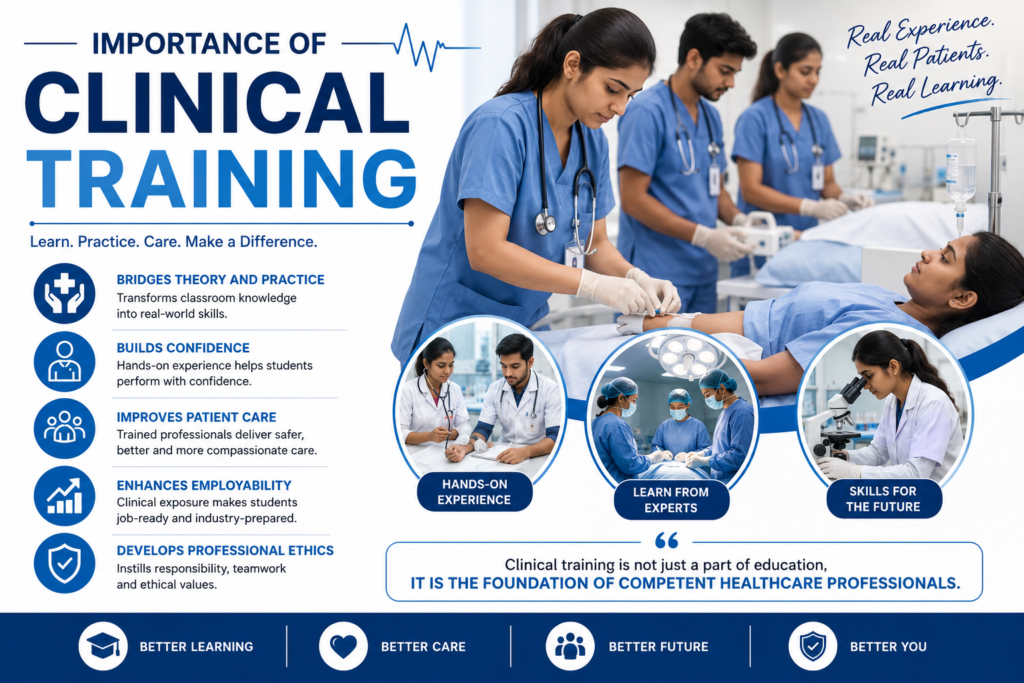
Importance of Clinical Training in Paramedical
Healthcare is a profession where knowledge alone is not enough. While classroom learning helps students understand medical concepts, clinical training provides the real-world experience needed to become a confident healthcare professional. It allows students to apply what they have learned in actual healthcare settings, preparing them for the responsibilities they will face in hospitals, laboratories, and clinics.
As India’s healthcare sector continues to grow, employers are increasingly looking for professionals who possess both theoretical knowledge and practical skills. Clinical training bridges this gap, making students job-ready from the beginning of their careers.
At Vasuganesan Institute of Medical Sciences (VGIMS), Chennai, clinical training is an integral part of every diploma program, ensuring students graduate with the confidence and competence required in today’s healthcare industry.
What Is Clinical Training?
Clinical training is practical, hands-on learning that takes place in hospitals, laboratories, and healthcare facilities. During this training, students work under the guidance of experienced healthcare professionals, observe medical procedures, and gradually perform tasks using the skills they have learned in the classroom.
Clinical exposure helps students understand hospital workflows, patient care standards, medical equipment, and professional responsibilities.
Why Is Clinical Training Important?
Clinical training prepares students for real healthcare environments by allowing them to practice their skills before entering the workforce.
Some major benefits include:
- Builds practical healthcare skills
- Improves confidence in patient care
- Develops problem-solving abilities
- Enhances communication with patients and healthcare teams
- Familiarizes students with hospital procedures
- Encourages professional ethics and responsibility
Students who receive quality clinical training adapt more quickly to workplace expectations after graduation.
Clinical Training in VGIMS Diploma Courses
At VGIMS, every diploma course includes practical learning to ensure students develop industry-relevant skills.
Students receive clinical exposure in programs such as:
- Diploma in Hospital Nursing & Midwifery (DHNM)
- Diploma in General Nursing & Midwifery (DGNM)
- Diploma in Medical Laboratory Technology (DMLT)
- Diploma in Dental Care Assistant (DDCA)
- Diploma in Electrocardiogram Technology (DECG)
- Diploma in Operation Theatre Assistant (DOTA)
Through practical sessions and supervised clinical experience, students gain confidence in performing professional healthcare responsibilities.
Skills Developed Through Clinical Training
Clinical training helps students build essential technical and professional skills, including:
- Patient care and monitoring
- Laboratory testing procedures
- ECG recording techniques
- Surgical assistance
- Dental assisting procedures
- Infection prevention and sterilization
- Medical equipment handling
- Teamwork and communication
- Time management
- Professional ethics
These skills prepare students to work effectively in modern healthcare environments.
Why Choose VGIMS for Clinical Training?
Clinical exposure plays a major role in career success, and Vasuganesan Institute of Medical Sciences (VGIMS), Chennai, emphasizes practical learning throughout its diploma programs.
Students benefit from:
- Experienced faculty guidance
- Modern laboratory facilities
- Practical skill development
- Hands-on clinical exposure
- Industry-oriented curriculum
- Supportive learning environment
By combining classroom education with practical experience, VGIMS ensures students are well-prepared for careers in hospitals, laboratories, operation theatres, dental clinics, and other healthcare organizations.
Conclusion
Clinical training is one of the most important aspects of healthcare education. It transforms classroom knowledge into practical skills, builds professional confidence, and prepares students for real-world patient care.
Students who receive quality clinical training are better equipped to meet the expectations of today’s healthcare industry. With experienced faculty, practical learning, and career-focused diploma programs, VGIMS helps students build a strong foundation for successful healthcare careers.
FAQs
1. Why is clinical training important in healthcare education?
Clinical training helps students apply theoretical knowledge in real healthcare settings, improving practical skills, confidence, and patient care abilities.
2. Which VGIMS diploma courses include clinical training?
VGIMS provides clinical training in Diploma in Hospital Nursing & Midwifery (DHNM), General Nursing & Midwifery (DGNM), Medical Laboratory Technology (DMLT), Dental Care Assistant (DDCA), Electrocardiogram Technology (DECG), and Operation Theatre Assistant (DOTA).
3. What skills do students gain through clinical training?
Students develop patient care, laboratory techniques, ECG procedures, infection control, communication, teamwork, medical equipment handling, and professional ethics.
4. How does clinical training improve career opportunities?
Clinical training makes students job-ready by providing real-world healthcare experience, helping them adapt quickly to hospitals and healthcare workplaces.
5. Why should I choose VGIMS for healthcare education?
VGIMS combines experienced faculty, modern laboratories, practical clinical exposure, and industry-oriented diploma programs to prepare students for successful healthcare careers.