
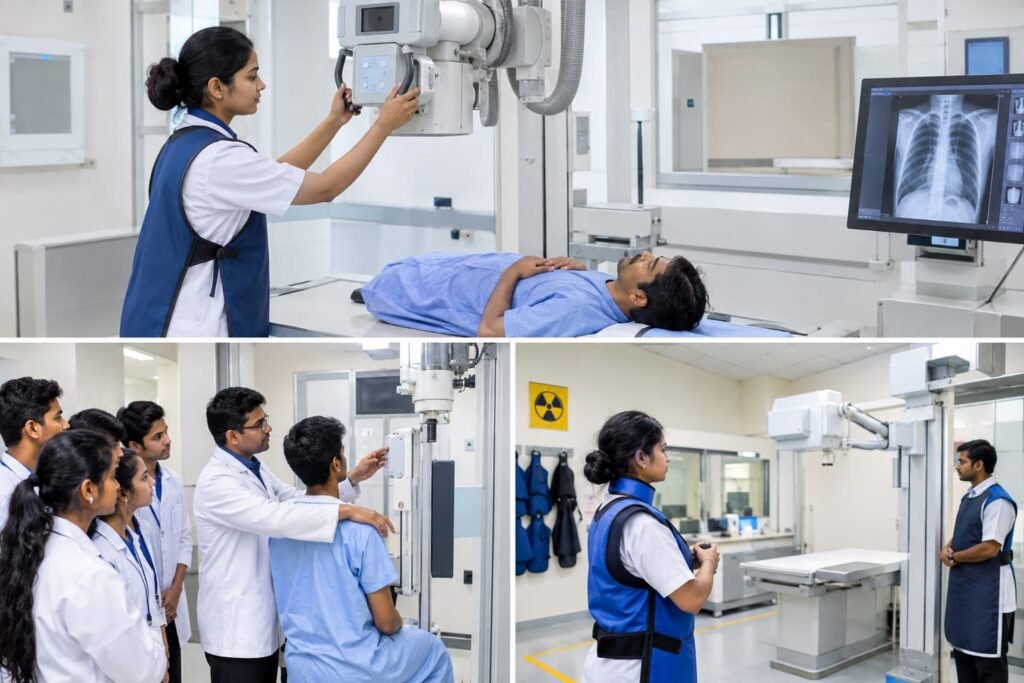
How X-Ray Imaging Supports Medical Diagnosis
X-ray imaging is one of the most widely used diagnostic tools in modern healthcare. It allows doctors to look inside the body without surgery and can provide valuable information about bones, the chest, and other internal structures.At VGIMS, understanding the role of diagnostic imaging is an important part of learning how healthcare professionals identify and manage different medical conditions.
What Is an X-Ray?
An X-ray is a medical imaging technique that uses a small amount of ionizing radiation to create images of structures inside the body. Different tissues absorb X-rays at different levels, producing an image that doctors can examine.Bones, for example, absorb more X-rays and usually appear white, while softer tissues appear in varying shades of grey.
How X-Rays Help in Medical DiagnosisX-ray imaging can support doctors in diagnosing a variety of conditions.
1. Detecting Bone FracturesX-rays are commonly used when a patient has suffered an injury. They can help identify fractures, dislocations, and changes in bone alignment.
2. Examining the Chest and LungsChest X-rays can provide information about the lungs, heart, and surrounding structures. They may help doctors evaluate conditions such as pneumonia, certain lung abnormalities, or other chest-related problems.
3. Identifying Joint ProblemsX-rays can help assess joints for abnormalities, injuries, arthritis-related changes, and other structural problems.
4. Supporting Emergency DiagnosisIn emergency departments, X-rays can provide relatively rapid imaging when doctors need information about injuries or certain medical conditions.
5. Monitoring TreatmentImaging may also be used to monitor how a condition is progressing or how a fracture is healing, depending on the patient’s clinical situation.
Why Clinical Interpretation MattersAn X-ray image should not be interpreted in isolation. Doctors consider the patient’s symptoms, medical history, physical examination, and other diagnostic information before reaching a conclusion.Radiologists and other appropriately trained healthcare professionals play an important role in reviewing medical images and communicating findings to the treating team.
Is X-Ray Imaging Safe?Modern medical X-ray examinations use controlled amounts of radiation. Healthcare professionals follow radiation-safety principles to keep exposure as low as reasonably achievable while obtaining the information needed for diagnosis.Patients should inform healthcare professionals if they are pregnant or may be pregnant before an X-ray examination.
Conclusion
X-ray imaging continues to be an important part of modern diagnostic medicine. By providing images of internal structures quickly and non-invasively, X-rays can help healthcare professionals identify injuries, investigate symptoms, and support appropriate treatment decisions.For medical students, learning the principles, applications, benefits, and safety considerations of X-ray imaging is an important foundation for understanding diagnostic radiology.
FAQ Section1. What is X-ray imaging used for?
X-ray imaging is commonly used to examine bones, the chest, joints, and other structures. It can help healthcare professionals identify fractures and other abnormalities.
2. How does an X-ray help doctors diagnose diseases?
An X-ray creates an image of internal body structures. Doctors interpret the image together with the patient’s symptoms, medical history, and other clinical information.
3. Are X-rays safe?
Medical X-rays use controlled amounts of ionizing radiation. Healthcare professionals follow radiation-protection principles to minimize unnecessary exposure while obtaining useful diagnostic information.
4. What are the three basic principles of radiation safety?
The basic principles commonly taught are time, distance, and shielding: minimize unnecessary exposure time, maximize appropriate distance from the radiation source, and use suitable shielding when required.
5. Can medical students enter an X-ray room?
Students should enter an X-ray examination room only when authorized and when their presence is necessary. They must follow the instructions of qualified radiology staff.