
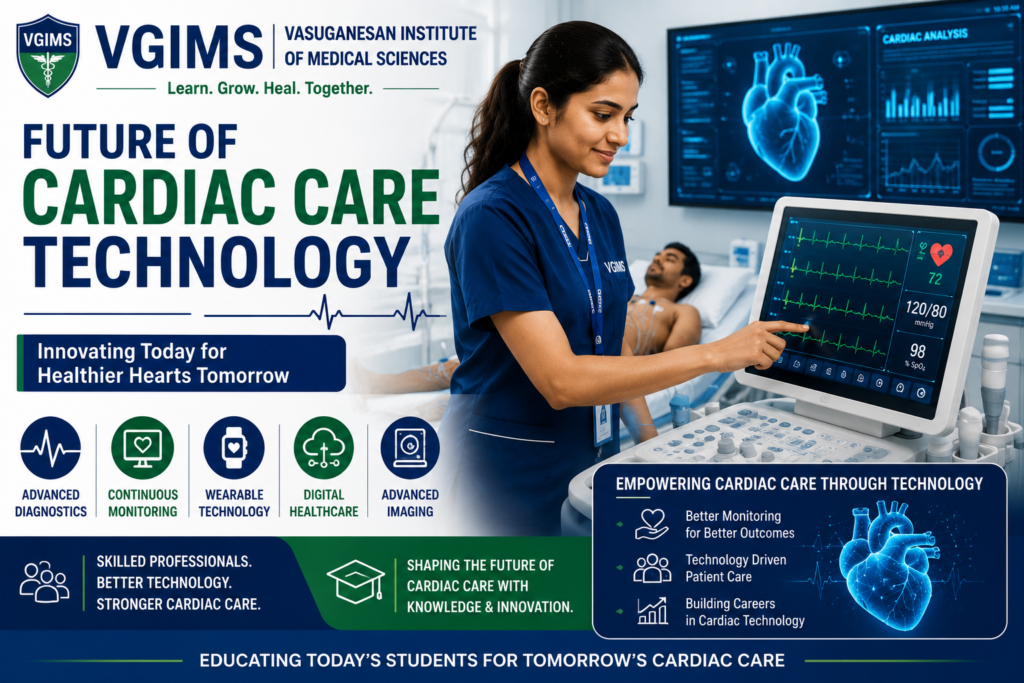
Future of Cardiac Care Technology
Cardiac care is changing fast because healthcare technology keeps getting better. New tools for diagnosis, digital monitoring systems and connected technologies give healthcare teams more ways to monitor and understand heart health.
If you are a student interested in cardiac care and healthcare technology, these changes show why skilled professionals who feel confident using modern medical tools are important.
What Is Cardiac Care Technology?
Cardiac care technology is the use of tools and tests that help healthcare professionals monitor and assess the heart and blood vessels.
Depending on the job, cardiac care technology can include:
- Electrocardiogram (ECG) systems
- Cardiac monitoring equipment
- Imaging
- Patient monitoring systems
- Digital health technologies
- Wearable monitoring devices
- Other cardiovascular diagnostic equipment
These tools help qualified healthcare professionals monitor patients and support their care.
How Is Cardiac Technology Changing?
Technology is making cardiac monitoring more connected, faster and more data-driven.
Here are some of the ways things are changing.
1. Advanced ECG Technology
An ECG is still an important tool for recording the electrical activity of the heart.
New ECG systems can create digital records that can be saved, shared and reviewed as part of a patient’s medical history.
For ECG professionals, knowing how to use the equipment correctly and obtain clear recordings remains very important.
2. Continuous Cardiac Monitoring
Traditional tests may show what is happening at a particular moment.
Continuous cardiac monitoring tools allow healthcare teams to monitor a patient’s heart activity over a period of time when clinically required.
This can be particularly useful in hospitals where patients may need ongoing monitoring.
3. Wearable Health Technology
Wearable devices make it easier to monitor certain health information outside a hospital.
Smartwatches and other wearable devices can collect health data such as heart rate and, in some cases, ECG-related information.
These tools can provide useful information, but they cannot replace a professional medical assessment or a doctor’s diagnosis.
4. Digital Healthcare
Digital healthcare is becoming an important part of modern medical services.
Digital records, connected equipment and digital communication can help healthcare teams access and manage patient information more efficiently.
In the future, cardiac care will likely see greater connection between medical equipment and digital healthcare systems.
5. Advanced Cardiac Imaging
Imaging technologies continue to be an important part of cardiac care.
New imaging systems can provide detailed images that help qualified healthcare professionals assess the structure and function of the heart and blood vessels.
People working with imaging technologies need appropriate training to use these machines safely and effectively.
Why Skilled Professionals Will Still Matter
Even as technology continues to improve, trained healthcare professionals remain essential.
Medical equipment must be:
- Used correctly
- Used safely
- Kept in working condition
- Used according to established procedures
- Used alongside professional judgement
Technology can support healthcare teams, but it does not replace the need for qualified professionals.
The Role of ECG Professionals in the Future
ECG professionals can play an important role in supporting cardiac diagnostic procedures.
Their responsibilities may include preparing patients, placing electrodes correctly, operating ECG equipment and obtaining clear recordings.
As ECG equipment becomes more digital, professionals will need a combination of:
- Knowledge
- Equipment-handling skills
- Patient-care skills
- Communication
- Attention to detail
- Comfort with digital tools
Career Opportunities in Cardiac Technology
As cardiac and diagnostic technology continues to develop, there may be opportunities across different healthcare environments.
Depending on qualifications, skills and employer requirements, ECG and cardiac technology professionals may explore opportunities in:
- Hospitals
- Diagnostic centres
- Cardiology departments
- Clinics
- Cardiac care facilities
- Medical diagnostic services
Job roles can vary based on training, experience and individual employer requirements.
Why Students Should Learn About Cardiac Technology
Students who want to build a career in healthcare can benefit from understanding how technology is changing cardiac care.
Learning about ECG and other diagnostic tools can help students explore a career that combines:
Healthcare + Technology + Patient Care
Hands-on learning can also help students become familiar with the equipment and procedures used in healthcare environments.
Cardiac Technology Education at VGIMS
Vasuganesan Institute of Medical Sciences (VGIMS) offers programmes in healthcare and allied medical fields, including:
- Diploma in Electrocardiogram Technology
- B.Sc. Cardiovascular Technology
- B.Sc. Imaging Technology
- B.Sc. Respiratory Technology
- B.Sc. Renal Dialysis Technology
- B.Sc. Medical Laboratory Technology
Students who specifically want to learn about ECG procedures and cardiac diagnostic support can explore the Diploma in Electrocardiogram Technology.
Students should check the latest information from VGIMS for eligibility, admission procedures, course duration and other programme details.
What Skills Will Future Cardiac Professionals Need?
People working in healthcare in the future will need both technical skills and the ability to communicate effectively with patients and healthcare teams.
Important skills include:
Technical Skills
Knowing how to use medical equipment and follow the correct procedures.
Digital Skills
Being comfortable using healthcare systems and new digital technologies.
Attention to Detail
Following procedures correctly and handling patient information and equipment carefully are important.
Communication
Patients need healthcare professionals who can communicate clearly and respectfully before and during procedures.
Teamwork
Cardiac care involves working with different healthcare professionals as part of a team.
Continuous Learning
Healthcare technology is always changing, so continued learning can be an important part of a healthcare career.
Conclusion
The future of cardiac care is closely connected to advances in healthcare technology.
From ECG systems and continuous monitoring to wearable technology and advanced imaging, these developments offer new ways to monitor heart health and support patient care.
For students interested in this field, developing technical skills, patient-care skills and communication skills can provide a strong foundation for working in modern healthcare environments.
Frequently Asked Questions
1. What is the future of cardiac care technology?
The field will likely continue developing through digital ECG, cardiac monitoring, imaging, wearable technology and connected healthcare systems.
2. Is ECG still important in cardiac care?
Yes. An ECG remains an important way to record the electrical activity of the heart.
3. Will technology replace healthcare professionals?
Technology can support healthcare professionals, but trained people are still needed to operate equipment, care for patients and make clinical decisions.
4. What skills are useful for a career in cardiac technology?
Technical knowledge, attention to detail, communication, patient-care skills, teamwork and digital skills can all be useful.
5. What cardiac-related courses are available at VGIMS?
VGIMS offers the Diploma in Electrocardiogram Technology and B.Sc. Cardiovascular Technology, along with other healthcare programmes.