
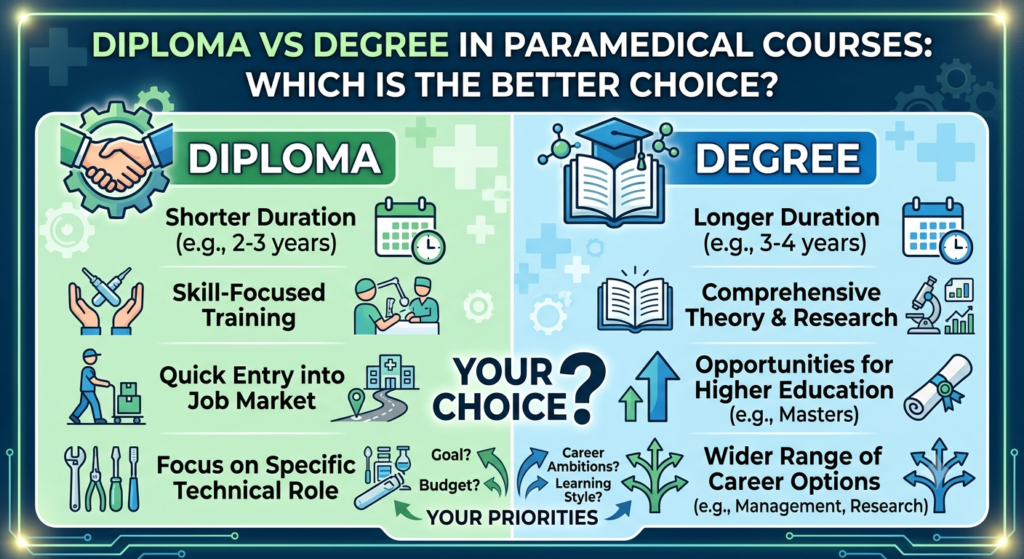
Diploma versus degree programs in paramedical fields
The healthcare sector offers many job options for those interested in medical science. A common question students face after high school is whether to pursue a diploma or a degree in paramedical courses. Both paths can lead to good careers, but they differ in how long they take, what you learn, job prospects, and chances for further education.
About Diploma Paramedical Courses
Diploma programs focus on practical skills and are shorter. They teach you the technical skills needed for jobs in hospitals, labs, clinics, and other healthcare settings.
These courses are a good fit for students who want to learn job-ready skills and start working quickly.
Benefits of Diploma Courses
- Shorter study time
- Lower costs
- Training focused on practical, real-world skills
- Quicker entry into healthcare jobs
- Good job prospects after finishing
These programs are great for students who learn best by doing and want to start their careers without spending many years in school.
About Degree Paramedical Courses
Degree programs offer a deep dive into medical science through theory, lab work, clinical practice, and research. They typically take longer but open up more career options and qualify you for postgraduate studies.
Students aiming for specialization or further education often choose degree programs.
Benefits of Degree Courses
- In-depth academic knowledge
- Extensive experience in clinical settings and labs
- Better chances for career advancement
- Eligibility for postgraduate studies
- More opportunities for specialized healthcare roles
Degree courses prepare students for long-term career growth in healthcare.
Diploma vs Degree: How They Compare
Here are some factors to consider when choosing:
Duration: Diploma courses usually take less time than degree programs.
Cost: Diplomas are typically less expensive than degrees.
Learning Style: Diplomas emphasize practical skills, while degrees offer a mix of theory and hands-on training.
Career Progression: Degree holders might have more options for advanced education and specialized roles. Diploma graduates can start working sooner.
Career Paths
Both diploma and degree graduates can have successful careers in healthcare. Depending on the specific course, job titles can include:
- Medical Laboratory Technician
- Operation Theatre Technician
- Healthcare Assistant
- Hospital Administrator
- Emergency Medical Technician
- Clinical Laboratory Professional
- Patient Care Executive
Jobs are available in hospitals, diagnostic labs, health centers, clinics, blood banks, and rehabilitation facilities.
Why Study at VGIMS?
VGIMS is dedicated to providing quality healthcare education through career-oriented diploma programs that meet the needs of today’s healthcare industry. The institute focuses on developing both theoretical knowledge and practical skills, ensuring students are ready for professional careers after completing their studies.
Students can choose from a variety of diploma courses including:
Diploma Courses
- Diploma in Medical Laboratory Technology (DMLT)
- Diploma in Operation Theatre Assistant
- Diploma in Dental Care Assistant (DDCA)
- Diploma in Hospital Nursing and Midwifery (DHNM)
- Diploma in General Nursing and Midwifery (DGNM)
Final Thoughts
VGIMS follows a practical learning approach by combining classroom teaching with laboratory sessions, clinical exposure, and hands-on training. Students learn under the guidance of experienced faculty and gain real-world healthcare experience that prepares them to work confidently in hospitals, diagnostic laboratories, clinics, and other healthcare organizations.
FAQs
Q1. Should I choose a diploma or a degree after Class 12?
Your choice depends on your career goals. Diploma courses help you start working sooner, while degree courses provide advanced knowledge and long-term career growth.
Q2. Are diploma courses more affordable than degree courses?
Yes. Diploma programs generally have lower tuition fees and shorter durations, making them a cost-effective option for many students.
Q3. What career opportunities are available after completing paramedical courses?
Graduates can work as Medical Laboratory Technicians, Operation Theatre Technicians, Healthcare Assistants, Hospital Administrators, and Emergency Medical Technicians in hospitals, laboratories, and healthcare centres.
Q4. Does VGIMS provide practical training for students?
Yes. VGIMS emphasizes laboratory sessions, clinical exposure, and hands-on learning to help students develop real-world healthcare skills.
Q5. Does VGIMS offer both diploma and degree programs?
Yes. VGIMS offers several diploma and degree programs in paramedical, nursing, and allied health sciences to meet different career goals.