
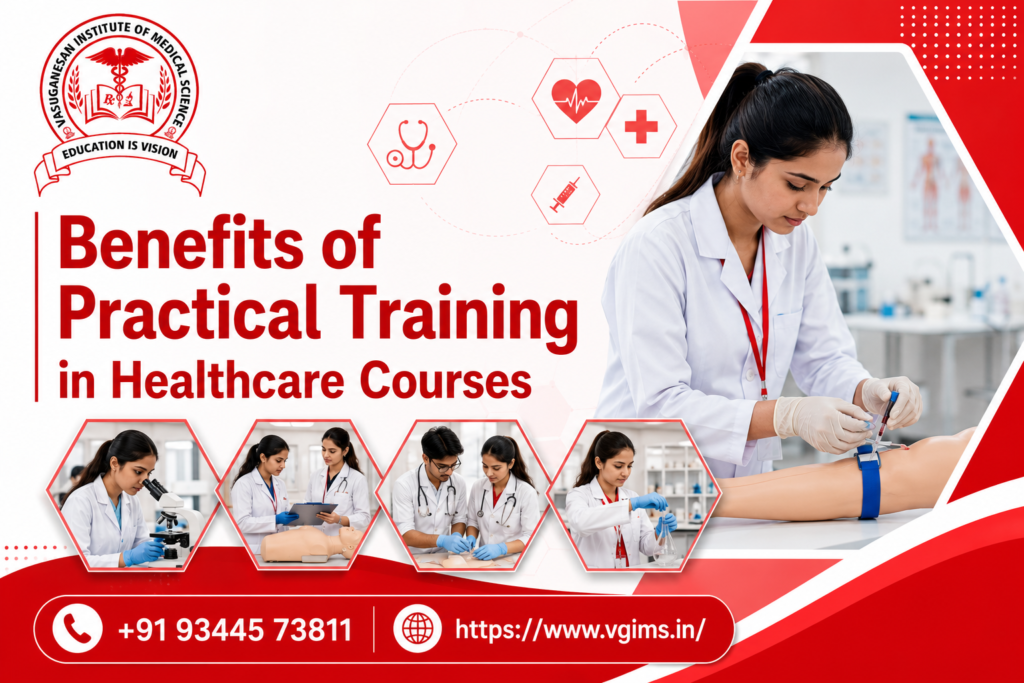
Beginner’s Guide to Practical Healthcare Training
Selecting a healthcare course is a great way to work toward a career that matters. Yet, a lot of students concentrate only on the content of the courses and forget to ask the crucial question, how much hands-on healthcare training does the course offer? Practical training is the main element that influences a student’s level of self-assurance, technical competency, and readiness for the work environment.
Practical training is a vital component of healthcare education at Vasuganesan Institute of Medical science (VGIMS). Besides theoretical lessons, students are exposed to medical procedures, healthcare instruments, and professional ethics through organized practical sessions. This harmony of teaching methods makes students ready for work in healthcare settings practically right from their academic entry point.
Understanding Practical Healthcare Training
Practical healthcare course training is about learning by doing. This means students get to see things in action watch demonstrations work in labs try out simulations and practice what they have learned under the eye of experienced people.
They do not just read about ideas in books. They actually see how healthcare services work.This way of learning helps students understand what healthcare professionals do every day. It also makes them feel more confident when they have to do things on their own in a setting. For people who are just starting out practical healthcare training helps turn the things they have learned in class into skills that they can use in real places, like hospitals, laboratories, clinics and diagnostic centres.
What Beginners Can Expect During Practical Sessions
Every healthcare course includes different practical components depending on the specialization. Students may participate in activities such as:
Clinical Demonstrations
Faculty members explain healthcare procedures using medical models, equipment, and demonstrations before students practice under supervision.
Laboratory Practice
Students learn how to use laboratory instruments safely, handle samples correctly, and follow quality standards in healthcare laboratories.
Equipment Familiarization
Healthcare technology continues to evolve. Practical sessions help students understand the operation and maintenance of commonly used medical equipment.
Professional Communication
Healthcare workers interact with patients, doctors, nurses, and caregivers every day. Practical learning improves communication, listening, and teamwork skills that cannot be fully developed through textbooks alone.
Why Hands-On Learning Makes a Difference
Students who actively participate in practical training often develop stronger professional abilities than those who rely only on classroom instruction.
Some key advantages include:
- Better understanding of medical procedures
- Greater confidence in handling clinical responsibilities
- Improved observation and analytical skills
- Increased awareness of patient safety protocols
- Stronger teamwork and coordination
- Better preparation for internships and employment
These benefits contribute to smoother career transitions after graduation.
Tips for Choosing the Right Healthcare Institute
Before taking admission, students should evaluate whether an institution offers meaningful practical exposure.
Consider these important points:
- Modern laboratories with updated equipment
- Experienced faculty members
- Practical-oriented curriculum
- Clinical observation opportunities
- Skill development activities
- Student guidance and academic support
Selecting an institute that emphasizes practical education helps students build both competence and confidence.
Preparing Yourself for Practical Learning
Students can make the most of practical healthcare training by developing positive learning habits.
Simple ways to prepare include:
- Attend every practical session regularly.
- Ask questions whenever concepts are unclear.
- Practice safety and hygiene protocols consistently.
- Maintain practical records carefully.
- Observe healthcare professionals closely during demonstrations.
- Continuously improve communication and teamwork skills.
These habits support long-term academic and professional growth.
Conclusion
Practical healthcare training is undoubtedly one of the most precious parts of healthcare education because it quite literally immerses students in the real life-demanding environment of the medical profession. Clinical work, laboratory sessions, and demonstrations are some of the ways that students gain the necessary expertise and confidence to successfully enter the healthcare workforce. Vasuganesan Institute of Medical science (VGIMS) is the perfect example of how academic knowledge can be enhanced with practical skills to produce well-rounded healthcare professionals with both the head and the hands that are necessary in the healthcare industry today. Students who are interested in pursuing a career in healthcare can check out the admission prospects at VGIMS and select a program that not only caters to their educational needs but also prepares them for their professional life.
Frequently Asked Questions (FAQs)
1. Is practical healthcare training compulsory in healthcare courses?
Ans Most healthcare and paramedical programs include practical training because students must develop clinical skills alongside theoretical knowledge.
2. When do students usually begin practical training?
Ans Depending on the course, practical sessions often begin during the early semesters and continue throughout the program with increasing levels of clinical exposure.
3. Why should I choose VGIMS for healthcare education?
Ans VGIMS focuses on combining classroom teaching with practical learning, helping students gain the skills and confidence needed for careers in healthcare and allied medical fields.
4. Do practical classes help students perform better during internships?
Ans Yes. Students who receive regular practical training usually adapt more quickly during internships because they are already familiar with healthcare procedures and workplace expectations.
5. How can I get admission to healthcare courses at VGIMS?
Ans Students can contact the VGIMS admissions team or visit the institute’s official website to learn about available courses, eligibility criteria, required documents, and the admission process.