
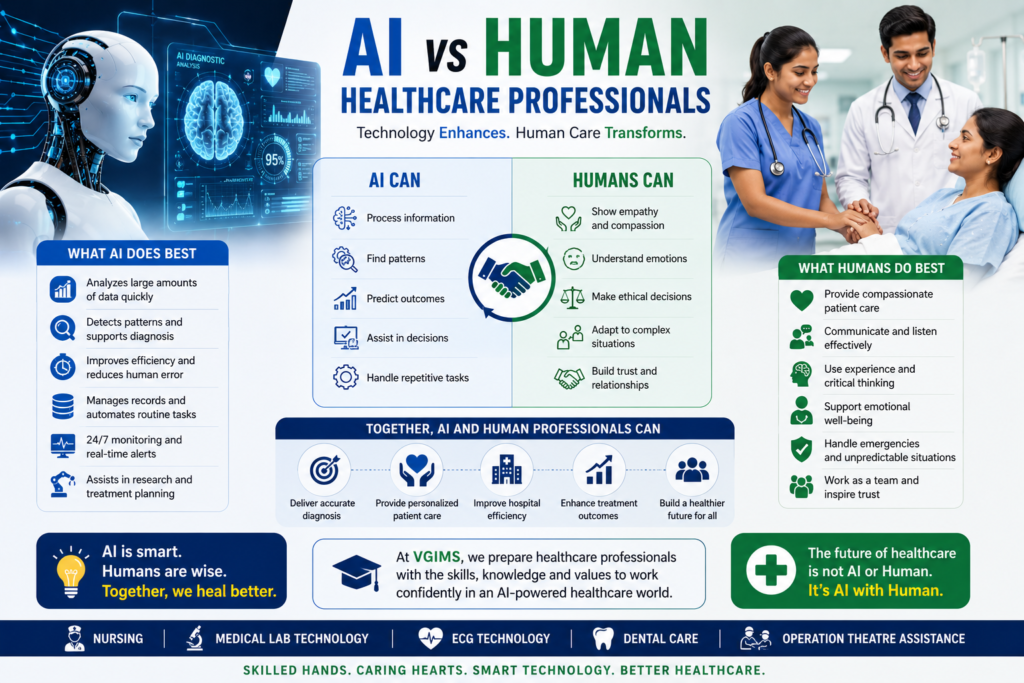
AI vs Human Healthcare Professionals
Artificial Intelligence (AI) is transforming the healthcare industry at an incredible pace. From assisting doctors in diagnosing diseases to analyzing medical reports and improving hospital operations, AI has become an important part of modern healthcare. However, despite these technological advancements, one question continues to arise: Can AI replace human healthcare professionals?
The answer is simple—AI is a powerful tool, but it cannot replace the knowledge, compassion, and critical thinking of trained healthcare professionals. Instead, AI and healthcare professionals work together to improve patient care, making healthcare faster, more accurate, and more efficient.
At Vasuganesan Institute of Medical Sciences (VGIMS), Chennai, students are trained with practical skills that prepare them to work confidently in a healthcare system where technology and human expertise go hand in hand.
The Growing Role of AI in Healthcare
Artificial Intelligence is helping healthcare professionals perform many routine and data-driven tasks more efficiently. Today, AI is used in hospitals and healthcare centres for:
- Analyzing medical images
- Supporting disease diagnosis
- Managing electronic health records
- Monitoring patient health
- Assisting in laboratory analysis
- Improving hospital workflow
- Predicting health risks using medical data
These innovations help healthcare teams make faster and more informed decisions.
What AI Can Do
AI excels at processing large amounts of information quickly and accurately. It can identify patterns in medical data that may not be immediately visible and assist healthcare professionals in making informed clinical decisions.
Some advantages of AI include:
- Faster data analysis
- Improved diagnostic support
- Reduced administrative workload
- Better medical record management
- Enhanced accuracy in repetitive tasks
- Continuous monitoring through smart devices
These capabilities improve efficiency and support better patient outcomes.
Why Human Healthcare Professionals Are Irreplaceable
While AI can analyze data, it cannot replace the human qualities that are essential in healthcare. Patients often need reassurance, emotional support, and compassionate communication—qualities that only trained healthcare professionals can provide.
Healthcare professionals are responsible for:
- Understanding patients’ emotional needs
- Making ethical and clinical decisions
- Responding to emergencies
- Building trust with patients and families
- Working collaboratively with healthcare teams
- Adapting to unexpected situations
These responsibilities require empathy, judgment, communication, and experience that technology cannot replicate.
AI and Human Professionals: A Strong Partnership
Rather than replacing healthcare workers, AI is becoming a valuable assistant that helps professionals perform their jobs more effectively.
For example:
- Medical Laboratory professionals use AI-supported diagnostic equipment while interpreting results accurately.
- ECG professionals work with advanced cardiac monitoring systems but rely on their knowledge to assist doctors.
- Operation Theatre Assistants support surgeries using modern medical equipment while maintaining patient safety and sterile environments.
- Nursing professionals combine technology with compassionate patient care.
The future of healthcare will depend on collaboration between advanced technology and skilled professionals.
Why Choose VGIMS for the Future of Healthcare?
As healthcare continues to adopt new technologies, students need practical education that prepares them for modern clinical environments. Vasuganesan Institute of Medical Sciences (VGIMS), Chennai, focuses on developing both technical knowledge and practical skills that remain valuable in the age of AI.
VGIMS offers industry-oriented diploma programs, including:
- Diploma in Hospital Nursing & Midwifery (DHNM)
- Diploma in General Nursing & Midwifery (DGNM)
- Diploma in Medical Laboratory Technology (DMLT)
- Diploma in Dental Care Assistant (DDCA)
- Diploma in Electrocardiogram Technology (DECG)
- Diploma in Operation Theatre Assistant (DOTA)
Students receive practical laboratory training, clinical exposure, and guidance from experienced faculty, preparing them to work confidently alongside modern healthcare technologies.
Conclusion
Artificial Intelligence is changing healthcare, but it is not replacing healthcare professionals. Instead, AI is enhancing the quality and efficiency of medical services by supporting doctors, nurses, laboratory technicians, and other healthcare workers.
The future belongs to professionals who can combine technical knowledge, practical skills, critical thinking, and compassionate patient care with modern technology. By choosing quality education at VGIMS, students prepare themselves for successful careers in a healthcare industry where both human expertise and AI play important roles.
FAQs
1. Can AI replace healthcare professionals?
No. AI can support diagnosis, data analysis, and hospital management, but it cannot replace human compassion, clinical judgment, communication, and patient care.
2. How is AI used in healthcare?
AI is used for medical imaging, disease detection, laboratory analysis, patient monitoring, electronic health records, and improving hospital efficiency.
3. Why are healthcare professionals still important in the age of AI?
Healthcare professionals provide empathy, ethical decision-making, patient interaction, emergency care, and critical thinking that AI cannot replace.
4. How does VGIMS prepare students for the future of healthcare?
VGIMS combines practical training, clinical exposure, and industry-oriented diploma programs to help students work confidently with modern healthcare technologies.
5. Which diploma courses are available at VGIMS?
VGIMS offers Diploma in Hospital Nursing & Midwifery (DHNM), General Nursing & Midwifery (DGNM), Medical Laboratory Technology (DMLT), Dental Care Assistant (DDCA), Electrocardiogram Technology (DECG), and Operation Theatre Assistant (DOTA).